



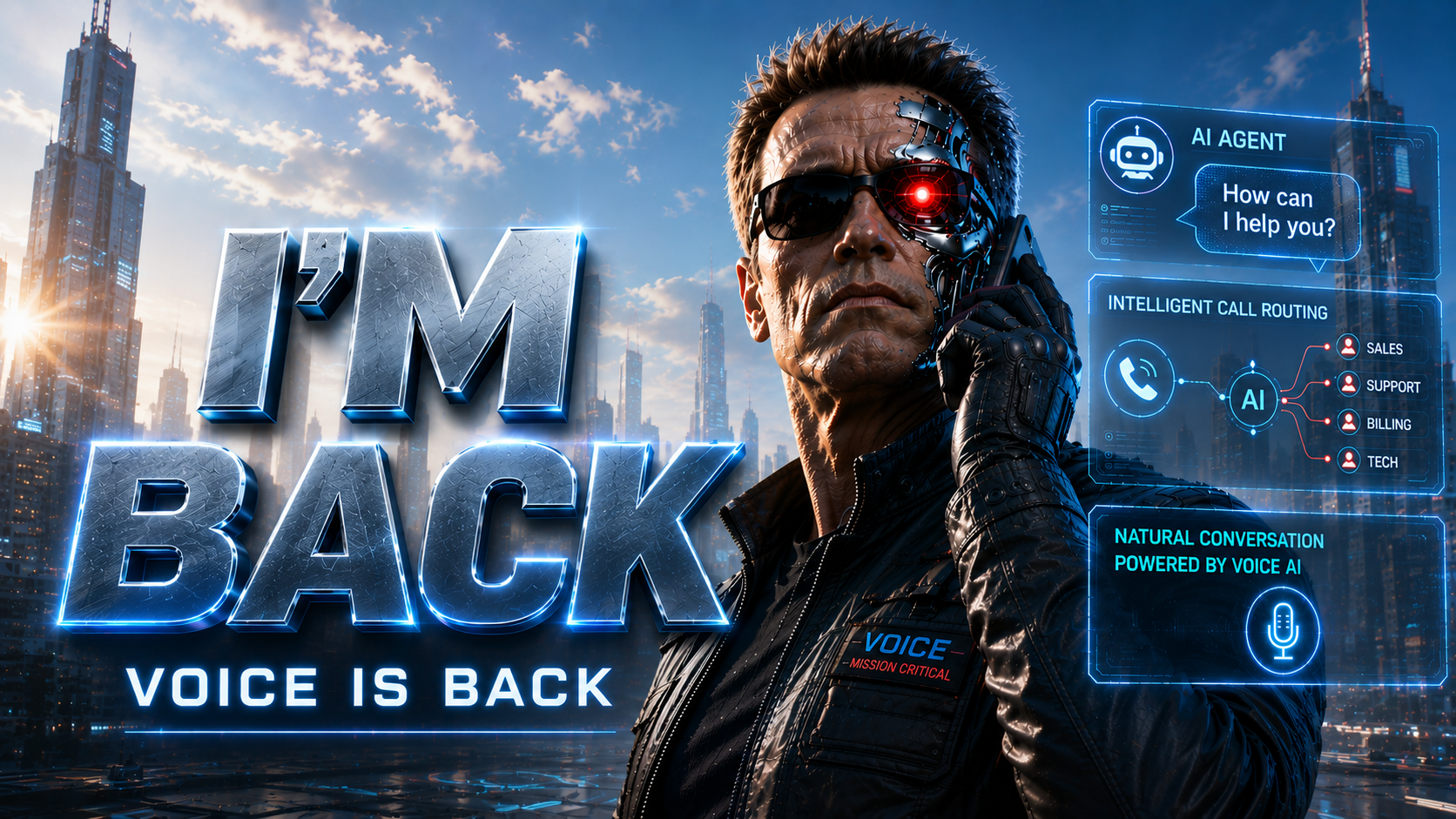

For the past decade or so, the Unified Communications (UC) industry has been focused on improving how people connect. Vendors competed on calling features, collaboration experiences, messaging capabilities, mobility, and video conferencing. The goal was straightforward: make communication faster, easier, and more accessible from anywhere.
Now, a new shift is emerging across the communications industry, one that moves UCaaS platforms beyond enabling conversations and into actively participating in business operations themselves. AI agents are rapidly becoming the catalyst behind that shift, fundamentally changing what organizations expect from their communications platforms.
This shift looks past efficient communications; rather, it looks to understand intent, take action, automate workflows, and engage customers intelligently in real time.
In many ways, AI agents represent the next major evolution of business communications.
Communications Platforms Are Becoming Operational Platforms
The first generation of cloud communications platforms digitized voice. The second generation unified collaboration through messaging, meetings, mobility, and cloud delivery. The generation of UCaaS that we are in now is shaped by autonomous intelligence embedded directly into communications workflows.
Historically, UCaaS platforms facilitated interactions between people. An employee answered a call. A receptionist routed a customer. A support agent handled a request. The communications platform acted primarily as the infrastructure layer underneath those interactions.
AI agents change that model entirely.
Modern AI agents can understand natural language, maintain conversational context across multiple interactions, retrieve information from connected systems, execute tasks, and escalate intelligently when human intervention is needed. Rather than simply routing a caller through a menu tree, AI agents can engage dynamically with customers in a way that feels conversational and contextual.
The difference between traditional automation and modern AI agents is significant. Businesses are moving away from rigid, frustrating IVR experiences toward intelligent conversational engagement. Instead of forcing customers to “Press 1 for Sales,” organizations are beginning to deploy systems capable of understanding requests naturally, responding contextually, and guiding interactions toward resolution.
Why UCaaS Is the Natural Home for AI Agents
The rise of AI agents is taking place directly inside UCaaS platforms, since these platforms already contain the real-time interaction layer that AI systems need in order to operate effectively.
This gives UCaaS providers a unique strategic advantage in the AI era.
AI agents thrive on context. They require access to conversations, workflows, routing logic, customer interactions, and business systems. Modern communications platforms already possess much of that infrastructure. As a result, AI agents are increasingly becoming the intelligence layer on top of communications ecosystems.
This shift is already showing up in customer behavior. Gartner predicts that by 2028, at least 70% of customers will use a conversational AI interface to start their customer service journey. For UCaaS providers, that is a major signal: the first interaction often begins through the very channels they already manage, voice, chat, SMS, routing, or a contact center queue.
What makes this particularly important is that businesses are beginning to rethink the role of communications technology altogether. Organizations are no longer evaluating UCaaS solutions solely based on calling features or collaboration tools. Increasingly, they are asking broader operational questions:
- Can this platform automate repetitive work?
- Can it improve customer responsiveness?
- Can it reduce staffing pressure?
- Can it streamline engagement across multiple locations?
- Can it help us operate more intelligently?
AI Agents Are Making Voice Strategic Again
One of the more interesting developments in this transition is the renewed strategic importance of voice.
For years, much of the technology industry shifted its focus toward messaging and collaboration experiences. Voice was viewed as a mature utility layer sitting quietly in the background while innovation centered around meetings, chat, and productivity applications.
AI agents are reversing that dynamic.
Voice is proving to be one of the most powerful interfaces for artificial intelligence because it remains the most natural form of human communication. Customers still prefer to explain problems conversationally. They want immediate engagement, real-time interaction, and the ability to speak naturally rather than navigate complex systems.
That creates an enormous opportunity for AI-powered voice interactions.
Unlike static digital forms or scripted chat experiences, voice conversations contain emotion, urgency, nuance, sentiment, and contextual detail. AI agents operating within voice environments can interpret intent more effectively and engage customers in ways that feel significantly more human.
As organizations adopt AI agents more aggressively, businesses are rediscovering the strategic importance of telephony infrastructure, SIP connectivity, intelligent routing, real-time communications reliability, and PSTN orchestration. The communications foundation itself suddenly becomes critical again because the quality of AI-driven experiences depends heavily on the quality of the underlying voice infrastructure.
The Business Case for AI Agents Goes Far Beyond Cost Reduction
Much of the public discussion around AI tends to focus narrowly on labor savings. While operational efficiency is certainly part of the equation, the real value of AI agents is far broader and far more strategic.
Businesses lose opportunities every day because customers reach out outside business hours, wait on hold too long, abandon calls, or fail to receive timely responses. AI agents allow organizations to maintain engagement continuously, providing instant interaction regardless of time of day or staffing availability.
For businesses with lean operational teams, this becomes particularly impactful. AI agents can handle repetitive inquiries, schedule appointments, answer routine questions, gather customer information, and escalate more complex issues to employees when necessary. That allows human staff to focus their time on higher-value interactions where empathy, expertise, or relationship-building matters most.
Scalability is another major advantage. Traditional staffing models struggle during spikes in demand, seasonal fluctuations, or multi-location growth. AI agents can scale interactions almost instantly without requiring proportional increases in headcount. For organizations operating across distributed environments, this creates a level of operational flexibility that traditional communications models simply cannot match.
There is also an intelligence layer that many organizations are only beginning to appreciate.
Every customer conversation contains valuable business insight. AI-powered communications systems can analyze interactions for sentiment trends, recurring issues, escalation patterns, customer frustration points, and operational bottlenecks. Over time, communications platforms begin evolving from transactional systems into strategic intelligence engines capable of informing broader business decisions.
The Most Important Shift
Perhaps the most important evolution underway is that AI agents are beginning to move beyond conversational assistance and into operational execution.
This is where the industry is truly headed.
The future of AI within communications is about enabling systems to take meaningful action on behalf of businesses and customers.
Modern AI agents are increasingly capable of updating CRM systems, sending follow-up messages, creating tickets, scheduling appointments, retrieving account details, initiating workflows, and escalating conversations with full contextual awareness. The communications platform is becoming an active participant in operational workflows.
That changes the role of UCaaS entirely.
Organizations are beginning to view communications platforms less as standalone productivity tools and more as intelligent operational hubs that connect customer engagement directly to business execution.
Vertical AI Will Become the Real Competitive Battleground
While general-purpose AI capabilities will eventually become expected across the industry, vertical specialization is where long-term differentiation will emerge.
Every industry communicates differently. Every vertical has unique workflows, compliance requirements, terminology, escalation paths, and customer expectations. AI agents that understand those nuances will create substantially more value than generic conversational systems.
Healthcare organizations require AI agents capable of understanding appointment scheduling, patient workflows, intake processes, and compliance-sensitive interactions. Hospitality businesses need intelligent guest engagement systems capable of handling reservations, concierge requests, multilingual support, and service coordination. Retail and restaurant environments require fast-moving customer engagement around orders, loyalty programs, store inquiries, and franchise operations.
Educational institutions, financial services organizations, legal firms, and countless other verticals will each demand AI systems tailored to the operational realities of their industries.
That is where the market is ultimately heading: not simply toward “AI-powered communications,” but toward industry-specific intelligent engagement platforms.
Human Trust Still Matters
Despite the excitement surrounding AI agents, organizations (and their customers) remain cautious and rightfully so.
Concerns around hallucinations, misinformation, compliance exposure, privacy risks, and poor escalation experiences are legitimate. Businesses understand that while automation can dramatically improve efficiency, poorly implemented AI can just as easily damage customer trust.
Recent market examples reinforce that point. McDonald’s decision to end its IBM-powered AI drive-thru trial shows that AI agents must perform in messy real-world conditions, background noise, customer frustration, edge cases, order complexity, and operational pressure. The lesson is not that voice AI lacks potential. The lesson is that AI agents must be designed for reliability, escalation, and real workflow complexity from day one.
The companies that succeed with AI agents will not be the ones that pursue automation at all costs. They will be the organizations that balance intelligence with governance, reliability, transparency, and human oversight.
Customers still want empathy during sensitive interactions. Employees still need visibility and control. Escalation paths still matter. Human judgment remains essential in complex situations.
The goal should not be to eliminate people from communications workflows altogether. The goal should be to create smarter systems that augment human capabilities, improve responsiveness, and reduce operational friction while still preserving the human experience where it matters most.
The Future of UCaaS Will Be Defined by Intelligent Engagement
The communications industry is entering a new phase, one that extends far beyond traditional telephony or collaboration.
The next generation of UCaaS platforms is here to understand interactions, automate workflows, orchestrate engagement, and help businesses operate more intelligently at scale.
Over the next several years, AI agents will increasingly become embedded across every layer of communications: voice, messaging, customer engagement, support, collaboration, workflow automation, and operational analytics. Businesses will begin evaluating communications providers not only on uptime, features, or user experience, but on how effectively their platforms can drive operational outcomes.
The organizations that recognize this shift early will gain a significant advantage because, ultimately, AI agents are changing the role communications technology plays inside the business itself.